


Thank you for being here. You are receiving this email because you subscribed to Idée Fixe (now rebranded as The Untapped Billion), the newsletter for curious motorsport insiders, read by Gen Z and the boardroom.
⏳ Reading time: 6 minutes
Shift Happens, weekly pivots where motorsport collides with tech and culture. A quick roundup of the headlines in and around motorsport you should be aware of, as they explain the cultural shifts we are seeing in this space.
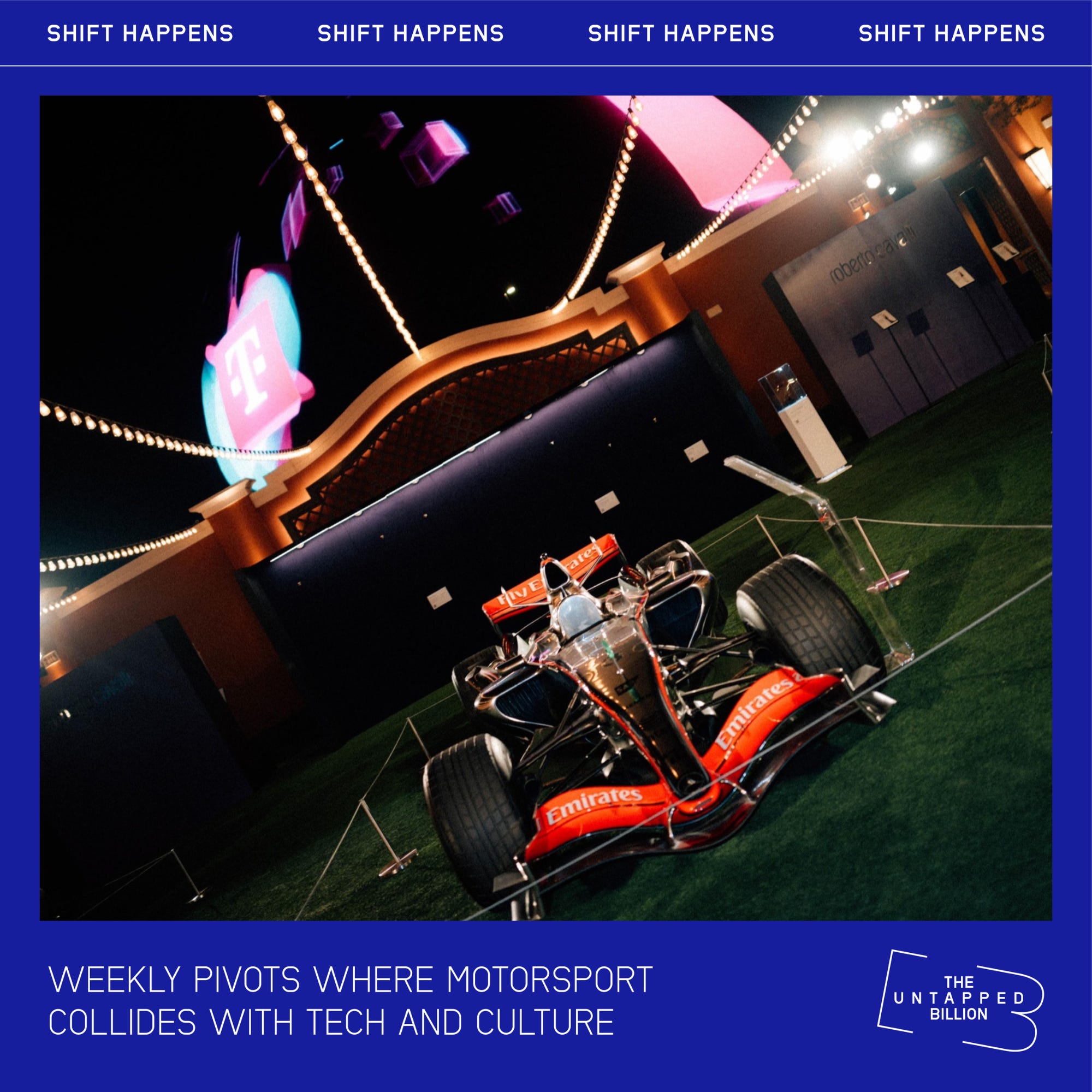
McLaren unveiled its biggest livery yet last week - on an Etihad Boeing 787 Dreamliner. This marks the first time an F1 team has been featured on an aircraft. I was supposed to attend as a guest of Etihad and McLaren, but Flighty - the app that tracks all your flights in one place - kindly reminded me that I was about to hit 70 flights this year; I decided not to add four more flights in November just before the LVGP.
Speaking of Vegas, I’ll do my best to cover what’s happening on the ground in the Substack chat, so be sure to join along. First up, Mission 44 just published their Igniting Inclusion report with three recommendations for F1, the FIA and all eleven teams. The message is clear - F1 risks losing talent if more is not done, and soon.

On Tuesday, I’ll be in conversation with Alex Albon, talking all things Formula 1, finding his style, getting engaged, and his first-ever cover shoot (he’s on the cover of Issue 08 of Esses magazine). You should join us if you are in Vegas. I’ll be keeping my eyes peeled for potential (and most likely) announcements from Nike, some beauty brands, Apple TV and Whoop, and I’m very curious to see which brands and teams end up on the sphere and which ones give us fun special liveries. And in case you missed it, Liberty Media had their quarterly earnings call - I’ll share some takeaways next week.

The [lead] lap
Last year, at a dinner hosted by J.P. Morgan, I said something that made a few people in the room shift in their seats, and it’s been on my mind pretty much ever since: I’m worried we’re building a generation of female influencers and losing a generation of female athletes in the process. I still believe it. I believe it more now.
Let’s start with the good news, because there’s a lot of it. Women didn’t get handed seats at these tables. We built our own tables. The platforms, the audiences, the sponsorship opportunities, the editorial voice in motorsport media… all of it came out of necessity, because nobody was offering us the mic. So we made our own. On our own terms, with full control over the work. Still today, if you scan the main broadcast lineups across traditional sports media, you can count the women presenting, reporting, and commentating on two hands. Meanwhile, scroll TikTok or Instagram or YouTube, and you will find hundreds of female football creators - analysts, commentators, journalists - filling every gap the broadcasters left open, building their own audiences, doing the work, often for free or for brand deals, because the door to the main stage was not wide enough.
And the same people who dismiss this work are watching it outperform their assumptions, and they don’t quite know what to do with that. Call it scrutiny if you want to be polite. I’ll call it what it is: envy. We built something real, with no intermediary, and we make our own money doing it. The numbers back up the bigger picture too. Women’s sports sponsorship grew 17.5% year over year in 2025, more than three and a half times the rate of men’s leagues. The WNBA’s sponsorship market alone went from $72.3 million in 2024 to $105 million in 2025, growing from $72.3 million in 2024 to $105 million in 2025.
Here’s where I get nervous. A wave of money is moving into women’s sports, yes, but a disproportionate amount of it is being routed around the athletes and straight into “content.” The numbers are stark. Among the fifteen highest-earning women in sports, endorsements made up roughly 70% of their income, compared with about 35% for the top fifteen men. For the bulk of their income, the top-earning women rely on endorsements, which accounted for 70% of income for the top 15 women, versus 35% for the top 15 men. Female athletes (and this isn’t unique to sports) rely on off-field endorsements two times more than men do. Put simply, women are effectively working a second job building a personal brand just to unlock a fraction of what their sport itself should be paying them.


And before anyone romanticises this as some universal path to riches, the data on “typical” professional women athletes, not the Caitlin Clarks or Coco Gauffs, tells a much colder story. So the “just become an influencer” pitch isn’t even a reliable upgrade for most. It’s a trade that works spectacularly for a handful of names at the very top and barely registers for everyone else, while the actual sport, the one they trained their whole lives for, stays underfunded at the base.
This is the trap I’m talking about. Not that brand deals exist. Not that female athletes are building platforms, audiences, businesses. Good. Do that. But when the most financially rational decision for a brilliant athlete or a sharp young executive is to quietly stop chasing the thing they’re actually elite at and start chasing the thing that pays the bills faster, that’s not actual progress. I’ve watched it happen. Women who trained their entire lives for a sport or built real expertise in a field, discovering they can make more money fronting a skincare line or beverage (for someone else’s company) than doing the job they’re brilliant at.
So when I see athletes choose ownership over ambassadorship, I pay attention. Most recently, Pierre Gasly didn’t just slap his name on an energy drink; he spent over two years building Minded from the ground up, his own functional beverage brand, not a logo-for-cash deal. Charles Leclerc co-founded LEC, a gelato label, with the Grom brothers in 2024, before launching his own apparel line, CL16, the following year. Those aren’t ambassadorships. Those are equity. Those are athletes betting on themselves as builders, not just faces. That’s the version of “brand extension” I want to see more women get the capital and structure to do, not just the invitation to post about someone else’s product. Just yesterday, pro athlete Cheriece Hylton, whom I met this summer at Cannes Lions, launched &Kaizen, which she describes as “a platform that connects athletes to the people, expertise and capital to build, launch and scale their own businesses.”
So here’s my ask, and it’s not complicated. We need brands investing in the athlete’s career, not renting her audience. Keep paying the women who built platforms from nothing; that work is real and it deserves real money. But stop letting “influencer” be the only financially viable identity available to a generation of women who were built to be something else entirely: champions, engineers, executives, team principals. Sponsor the series. Pay the athlete what she’s worth on the field, not just what she’s worth in a caption. Make the ambassador role the second job, not the only one.
Because if we don’t, we’re not going to lose individual athletes. We risk missing out on a whole generation of them, quietly, to a spreadsheet that simply made more financial sense.
Three [stories] on my radar
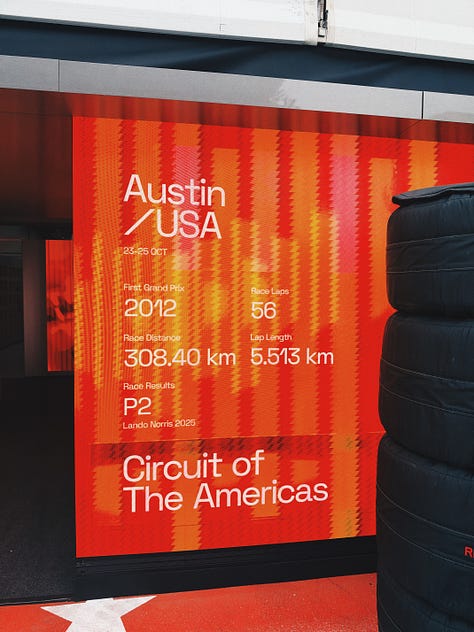
This one kind of fell through the cracks, but I was mesmerised by Oscar Piastri’s helmet during the Austin GP. McLaren announced Intel in May as the Official Compute Partner of the F1 team and the Arrow McLaren IndyCar team, and the Intel branding went on both F1 cars from Montreal onwards. In Austin, the helmet caught my eye as I thought the design was pretty cool (see below), and it was such a unique design - the whole shell is drawn as a magnified chip surface, with a square processor and the Intel logo sitting on the crown, and the number 81 is in white on black at the back.
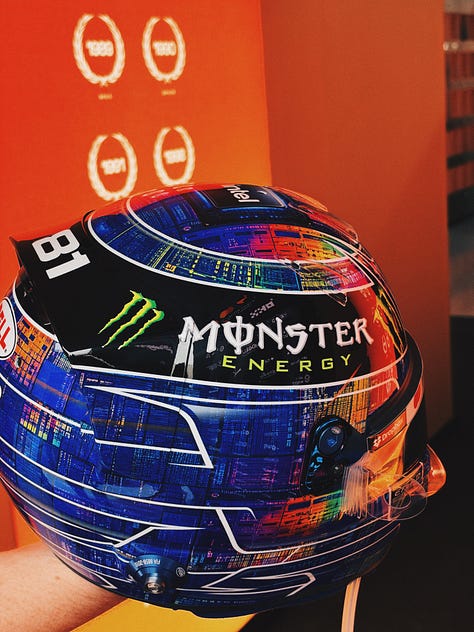
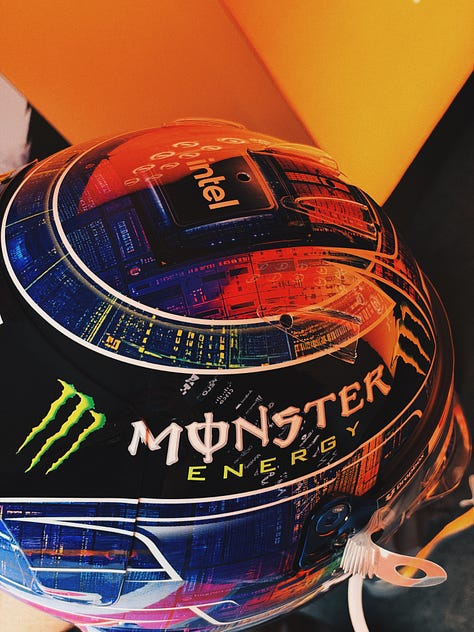
Oscar Piastri's Intel Austin helmet On Friday last week, it was announced that the newly crowned F1 Academy champion, Alisha Palmowski, will join the Red Bull Junior Programme from 2027. After two years with the Red Bull Racing Academy Programme in the all-female racing series, F1 Academy, this is a great next step for Alisha’s racing career. I spent the day yesterday with the team and VISA on a very exciting project. More on this soon.
Last week, an F1-accredited journalist was handed a three-race ban - no media accreditation for the journalist (not a ban for the whole outlet) for the remainder of the season. This brought up a brilliant discussion about freedom of the press, free speech, journalistic integrity, and hate speech. I did a four-minute breakdown here if you are interested, and it starts with revisiting one of my favourite movies, Notting Hill.


What I told [my clients] this week

[Bon goût] - for those with an acquired taste.
Meyers Manx very kindly sent me a few pieces from their new Airways collection. At a time when almost every cool brand seems to be leaning into motorsport-influenced collections, it’s actually refreshing to have an automotive brand put out a collection inspired by aviation. And the collection is good. That’s it from me this week; now off to Vegas I go. See you there.


If you have a topic you wish to discuss, a tip or a pitch for Untapped Billion,
email t.cowanbrown@gmail.com
I’m Toni Cowan-Brown, a tech and F1 commentator, accredited journalist and the Editor-At-Large at Esses. I’m a former tech executive who has spent the past six years on the floor of way too many F1, FE, and WEC team garages, learning about the business, politics, culture and technology of motorsports.
Toni, thank you for writing this. We were struck by endorsements making up about 70% of income for the top 15 women, against 35% for the top 15 men. We read that 70% as a small base salary more than big brand money. "Make the ambassador role the second job, not the only one" is advice every team and series should hear. Credit to Red Bull for backing Alisha Palmowski with a place in its Junior Programme for 2027, and we look forward to hearing about your project with the team and Visa, especially if Alisha is part of it!
Brands pay women to post because it’s cheaper than paying them to compete. The fix is pricing the performance, not the follower count. Results on track are the reason anyone is watching in the first place.